Quick answer
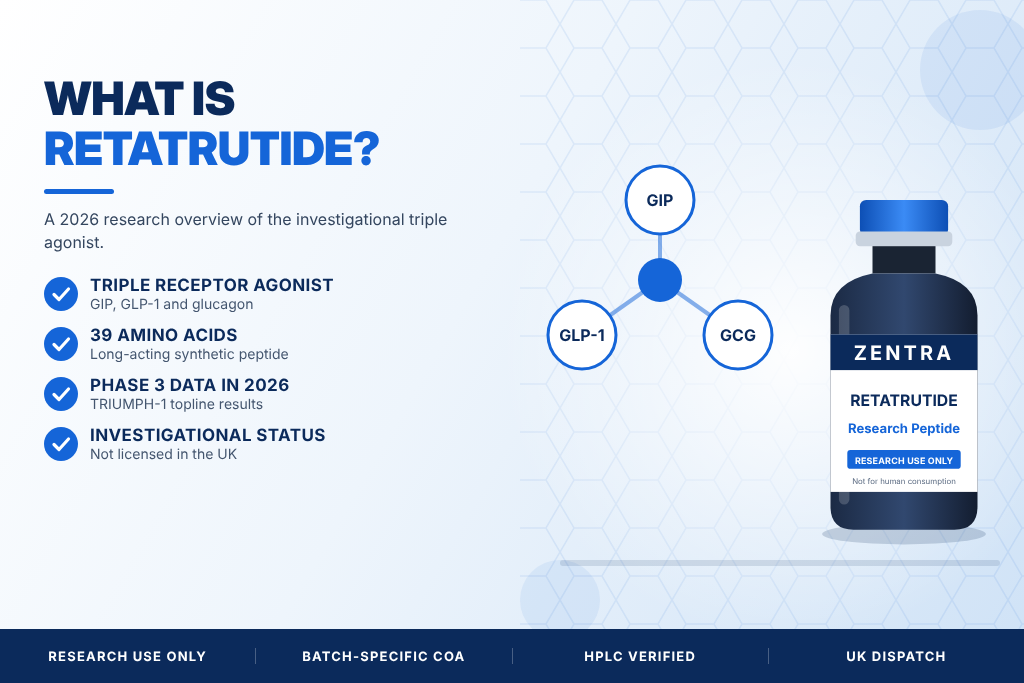
Retatrutide (LY3437943) is an investigational peptide developed by Eli Lilly that activates three receptors: GIP, GLP-1 and glucagon. It is in phase 3 clinical trials and is not licensed as a medicine in the UK or any other country. Outside those trials it is available only as a laboratory research material.
What retatrutide is
Retatrutide is a synthetic peptide of 39 amino acids. A fatty acid chain attached to the peptide backbone lets it bind to albumin in the blood, which slows its clearance. This is the same general design approach used in other long-acting incretin analogues. In trials it is given once a week, which reflects a half-life of about six days.
It is often called a triple agonist or “triple G” compound because of its three receptor targets. That sets it apart from semaglutide, which acts on one receptor, and tirzepatide, which acts on two.
How it compares with earlier compounds
| Compound | Receptor targets | Developer | UK status |
| Semaglutide | GLP-1 | Novo Nordisk | Licensed prescription-only medicine |
| Tirzepatide | GIP, GLP-1 | Eli Lilly | Licensed prescription-only medicine |
| Retatrutide | GIP, GLP-1, glucagon | Eli Lilly | Investigational, not licensed |
Our comparison of retatrutide, tirzepatide and semaglutide looks at the receptor pharmacology of all three in more depth.
Why the third receptor matters to researchers
GLP-1 and GIP are incretin hormones involved in insulin secretion and appetite signalling. Glucagon has a different role. It raises blood glucose, but it also increases energy expenditure and affects how the liver handles fat.
The research question is whether adding glucagon receptor activity changes the overall metabolic effect, and whether the glucose-raising action of glucagon is offset by the two incretin components. This makes retatrutide a useful tool for studying how these three pathways interact, which is why it features heavily in current metabolic research.
What the 2026 phase 3 data showed
Eli Lilly announced topline results from the TRIUMPH-1 trial on 21 May 2026. As reported by The Pharmaceutical Journal, the trial randomised 2,339 participants to one of three retatrutide doses or placebo. The trial is registered as NCT05929066.
| Group | Average weight change at 80 weeks | Stopped due to adverse events |
| Retatrutide 4 mg | 17.6% | 4.1% |
| Retatrutide 9 mg | 23.7% | 6.9% |
| Retatrutide 12 mg | 25.0% | 11.3% |
| Placebo | 3.9% | 4.9% |
In a subgroup of 532 participants with a starting BMI of 35 or above, weight loss reached up to 30% at 104 weeks.
Two earlier trials reported similar direction of effect. TRIUMPH-4 recorded an average 28.7% loss at 68 weeks on the 12 mg dose in people with obesity and knee osteoarthritis. TRANSCEND-T2D-1 recorded 16.8% at 40 weeks in people with type 2 diabetes.
These figures come from controlled clinical trials using pharmaceutical-grade material under medical supervision. They do not describe research-grade material and should not be read as guidance for any use outside a trial.
Adverse events reported
The most common adverse events were gastrointestinal. At the highest dose, nausea was reported by 42.4% of participants, diarrhoea by 32.0%, constipation by 26.1% and vomiting by 25.3%.
Dysesthesia, an abnormal skin sensation, and urinary tract infections were each reported in about 1 in 10 participants on the higher doses. The discontinuation rate at 12 mg was more than double that of placebo. Long-term safety data is still being collected.
Open research questions
The phase 3 results answer some questions and leave others open. Researchers are still working on several points:
- How much of the effect persists after treatment stops has not been reported for the full programme.
- Body composition. Total weight change does not show how much of the loss is fat and how much is lean tissue.
- Liver fat. Earlier phase 2 work reported large reductions in liver fat, and the glucagon component is the suspected driver.
- The dose-related rise in discontinuation suggests the titration schedule matters.
- Head-to-head data. Comparisons with tirzepatide so far come from separate trials with different populations and durations, so the figures cannot be set side by side with confidence.
These gaps are why retatrutide remains an active subject in receptor pharmacology and metabolic research, beyond the headline numbers.
Regulatory status in the UK
Retatrutide has no marketing authorisation from the MHRA, the European Medicines Agency or the US FDA. A regulatory submission had not been made at the time of the May 2026 results, and approval is not expected before 2027 at the earliest.
This means retatrutide cannot lawfully be sold, prescribed or advertised as a medicine in the UK. Our guide to research use only explains what that designation covers and what it does not.
Laboratory considerations
Researchers working with retatrutide as a reference material should check three things before use.
Identity. The compound has a molecular weight of roughly 4,731 Da. A mass spectrometry result on the Certificate of Analysis should be consistent with that figure. Our guide to reading a peptide COA explains where to find it.
Purity. HPLC purity should be reported with a chromatogram, not only as a single percentage.
Storage. Lyophilised peptides degrade with heat, light and moisture. See how to store research peptides for recommended conditions.
Zentra Labs supplies retatrutide for laboratory research with batch documentation. It is not supplied for human or animal use.