A Certificate of Analysis rarely comes with much explanation attached to it. Researchers reviewing the document may encounter a purity value, such as 98.7% or 99.3%, and reasonably interpret it as a complete measure of quality. However, this figure represents only one aspect of the material’s overall characteristics. Anyone asking what does HPLC purity mean peptides testing actually captures needs to understand not just the figure, but the method behind it, and what that method can and cannot tell you.
This article sets out how HPLC works, why the resulting percentage deserves closer scrutiny than it usually gets, and what separates a genuinely informative COA from one that merely looks reassuring.
It also explains why the label “HPLC tested peptides” means little on its own unless the result is batch-specific and supplied with the underlying chromatogram.
What HPLC Is and Why It’s Used for Peptides
High-Performance Liquid Chromatography, or HPLC, is an analytical method used to separate the different components within a sample and measure how much of each is present.
- For peptides, this matters a great deal, because synthesis is not a process that produces a flawless result every time. Side reactions occur, and fragments are left behind. Some material never reacts fully.
- HPLC is how a laboratory quantifies exactly how much of the finished product is the intended peptide, and how much is something else entirely.
- Without this kind of testing, a researcher would be working from assumption rather than evidence, which is not a position anyone wants to be in when the accuracy of a study depends on knowing precisely what’s in the sample.
The Mechanics Behind the Test
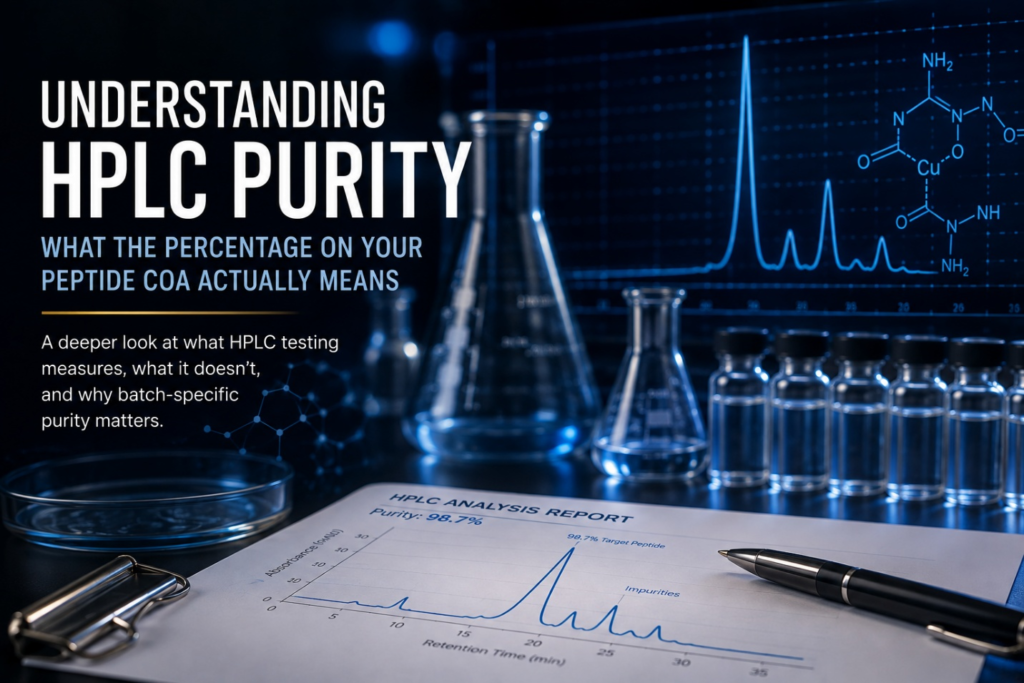
During analysis, a dissolved sample is passed through a column filled with a material that interacts differently with each compound present. Because of these differing interactions, components move through the column at different rates and exit at different times.
- A detector then records each one as it emerges, and the result is a chromatogram made up of a series of peaks.
- The largest peak generally corresponds to the target peptide. Smaller peaks scattered around it represent impurities, related substances, or degradation products left over from manufacturing.
- Purity is then calculated by dividing the area beneath the main peak by the total area of every peak recorded.
- A result of 99%, in other words, indicates that roughly 99% of what was detected matches the intended compound, with the remaining 1% belonging to something else.
Why the Percentage Alone Doesn’t Tell You Everything
It is easy to treat that single figure as the final word on quality, but a closer look at how the number is produced tells a slightly more complicated story.
Two suppliers can both report 99% purity and still be describing materials of noticeably different reliability. The reasons for this include:
- The detection wavelength chosen during testing, which affects which impurities become visible at all
- The specific column and gradient method used, since these influence how well the test resolves closely related substances
- Variation in how different laboratories calculate and round their final figures
Because of these variables, the credibility of the testing laboratory matters at least as much as the percentage itself. A result generated in-house, without external verification, carries considerably less weight than one produced by an independent facility with recognised accreditation.
Generic Certificates Versus Batch-Specific Testing
One issue that comes up often in the research peptide space, though rarely discussed openly, is the use of certificates that aren’t actually tied to the batch a researcher has in front of them.
- A generic template, reused across several production runs, tells you almost nothing about the specific vial you’re holding. A batch-specific COA, produced through independent testing, is a different matter altogether.
- Zentra Labs tests every batch individually through UK-accredited laboratories rather than relying on recycled documentation, so the certificate a researcher receives actually reflects the material that was shipped to them, not a general approximation of what the product should look like.
Why Purity Levels Differ Between Suppliers
Purity is not a fixed outcome. It depends on decisions made well before a COA is ever generated.
Synthesis Method and Scale
Smaller, closely monitored production runs tend to produce more consistent results than large-scale manufacturing, where throughput is sometimes prioritised ahead of precision. This isn’t a universal rule, but it is a pattern seen frequently enough to matter.
Storage and Handling After Manufacturing
A peptide can leave a laboratory at 99% purity and arrive somewhere else in noticeably worse condition. Heat exposure, moisture, and repeated freeze-thaw cycles all contribute to degradation over time. This is precisely why cold-chain logistics carries so much weight in this field; testing accuracy at the point of production is only meaningful if handling afterwards preserves it.
How Openly a Supplier Shares Testing Data
Some suppliers publish full, batch-specific results without being asked. Others provide vague documentation, outdated certificates, or nothing at all beyond a marketing claim of “high purity.” For anyone relying on these materials for legitimate laboratory work, testing transparency should be treated as a baseline requirement rather than a bonus.
What to Look for When Reading a COA
A handful of details separate a useful certificate from a decorative one:
- Batch number, confirms the document actually corresponds to the product received
- Purity percentage, generally expected above 98% for most research applications
- Testing method, HPLC is the accepted standard, sometimes paired with mass spectrometry for identity confirmation
- Testing laboratory, independent accreditation carries far more weight than internal testing alone
- Date of analysis, indicates whether the data is current
If any of these are missing, vague, or inconsistent with the product received, it is reasonable to raise the question directly with the supplier before proceeding.
Purity Expectations Across Different Compound Types
Expectations shift slightly depending on the compound in question and its intended research use, though the underlying testing standard should remain consistent throughout.
- Researchers working with5 Amino will want the same rigour applied to their COA as anyone studying a more complex molecule.
- The same standard applies toEpithalon, where batch-specific verification matters just as much for smaller-scale research projects as for larger ones.
- Compounds intended for more specialised study bring their own considerations.ARA-290 is one such example, where researchers benefit from clear documentation of both identity and purity before any experimental work begins.
- Semax, supplied as a premium-quality lyophilised research compound, follows the same principle.
- Melanotan IIis worth mentioning specifically here, as it is a high-purity synthetic peptide supplied as a 10mg lyophilised powder used in studies involving melanocortin receptor activity, peptide signalling, and neurological pathways. It is intended strictly for research purposes, and its usefulness to any given study depends entirely on knowing precisely what the vial contains.
- This need for clarity isn’t limited to peptides in the strictest sense. Materials commonly used alongside peptide research, such asB12, benefit from the same principle of transparent documentation. So does Glutathione, where researchers should never be left guessing about composition or concentration.
Why Where a Peptide Is Tested and Stored Matters
Supply chain integrity affects research reliability just as much as the synthesis process itself. Overseas suppliers often introduce longer transit periods, inconsistent cold-chain handling, and customs delays, any of which can compromise a sample before it reaches a laboratory bench.
- A supply chain rooted entirely within the UK reduces these risks considerably. When synthesis, testing, and storage all take place domestically, traceability improves, and compliance becomes far simpler to manage.
- Zentra Labs was founded in 2019 by a group of biochemists and quality engineers who identified a specific gap in the UK market: a shortage of research-grade peptide suppliers willing to be genuinely transparent about provenance and testing. That founding principle still shapes how each batch is tested, documented, and dispatched today.
HPLC purity is not a number included for reassurance alone. It reflects how much confidence a researcher can reasonably place in the material they are working with, and understanding how that figure is produced changes how it should be interpreted. Accreditation, batch specificity, and post-manufacture storage all shape what a percentage genuinely represents.
Purity data works best as one part of a wider picture, alongside proper handling and honest communication from suppliers about what is, and isn’t, known about a given compound.
Conclusion
Researchers exploring BPC-157 10mg will find the same principle applies there as anywhere else. It applies equally to GHK-Cu 100mg, where documentation should be just as rigorous. The same is true of Retatrutide, Tirzepatide, and Semaglutide; in each case, reviewing batch-specific HPLC documentation before use is one of the simplest steps a researcher can take to protect the integrity of their work.
The full range of independently tested, UK-stored research compounds is available through the Zentra Labs shop.
For further detail on testing standards and compliance practices, the FAQ page provides additional context.