Copper has been recognised as essential to human biology for well over a century. Its connection to one particular tripeptide, though, wasn’t actually understood until the 1970s. The discovery came about almost by accident, during a study of blood plasma, and it introduced researchers to a compound now known as GHK-Cu. Few copper-binding peptides have been documented as extensively since.
Anyone typing “GHK-Cu research peptide” into a search bar will land on a genuinely large body of literature. Some of it dates back decades; some of it is far more recent. Together, it covers everything from basic cell behaviour to fairly narrow mechanistic questions that are still being worked out today.
How the Peptide Was First Identified
A researcher studying plasma samples in 1973 noticed something odd. Older and younger individuals showed markedly different concentrations of a naturally occurring copper-binding tripeptide.
- That single observation was enough to set off decades of follow-up work, first into the compound’s structure, then into its role in copper transport, and eventually into its broader involvement in cellular processes.
- Most peptides used in research today were built from the ground up specifically for laboratory work.
- GHK-Cu didn’t follow that route. It was found first, occurring naturally in the human body, and only synthesised afterwards for controlled study. That gives it a research history considerably longer than most compounds currently on a lab bench.
What the Molecule Looks Like
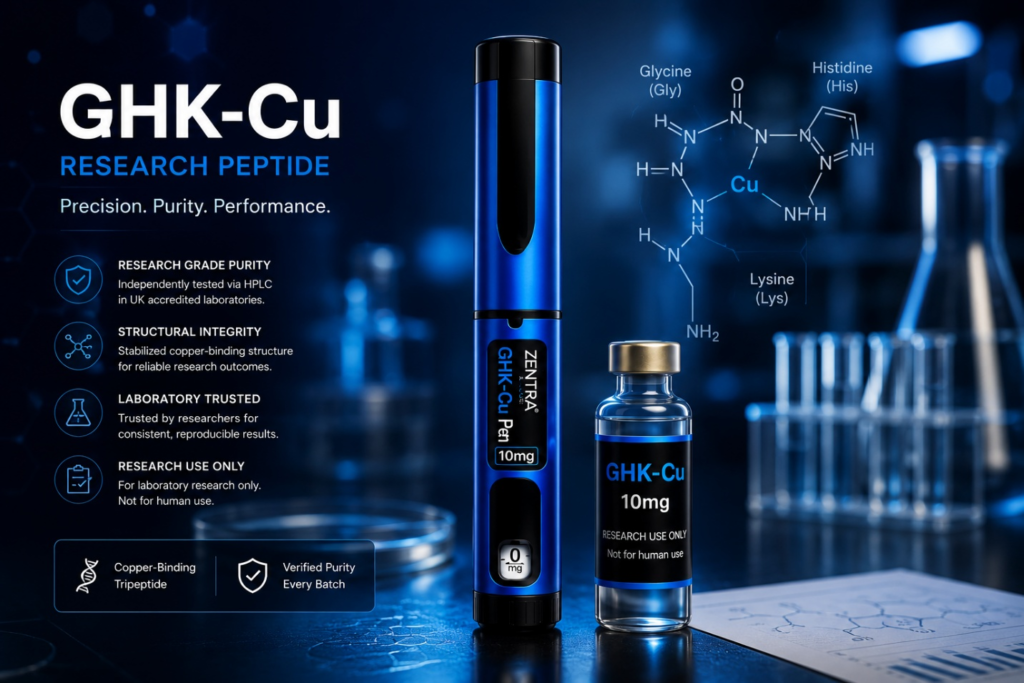
Structurally, there isn’t much to it. Three amino acids (glycine, histidine, and lysine) bound to a single copper ion. That is small, by peptide standards. What matters biologically isn’t the size, though; it’s the copper affinity. A handful of points sum up the structure fairly well:
- It’s among the smallest peptides studied in copper-related work
- The arrangement of its amino acids allows for tight, selective binding to copper ions
- That binding behaviour is, more or less, the reason the surrounding literature exists at all
Because so much of the compound’s relevance traces back to this single property, most research questions eventually circle back to how copper binding influences what happens inside a cell.
Where the Research Has Gone
Over the decades since GHK-Cu was first isolated, investigation has spread across several fairly distinct areas. Much of it, worth repeating, sits at the cellular or animal-model stage. Human trial data is comparatively thin.
Moving Copper Into Cells
Early studies asked a fairly narrow question: how does this peptide help copper get where it needs to go inside a cell?
- Copper acts as a cofactor for a long list of enzymes, so understanding its delivery mechanism has been a recurring thread through the literature almost from the beginning.
- Some later work pushed further, looking at how this transport process interacts with copper-dependent enzyme systems. That’s added texture to a broader scientific picture of how trace elements move through metabolic pathways.
Gene Expression
A newer strand of research has looked at gene activity. Several studies using tissue models recorded shifts in expression patterns after exposure to GHK-Cu, with particular attention paid to genes tied to tissue remodelling.
This area is still fairly young, comparatively speaking. Most of what’s published so far comes from in vitro work, not anything approaching clinical trials.
The Extracellular Matrix
There’s also a body of work examining how GHK-Cu interacts with the extracellular matrix – the structural scaffolding positioned around and between cells.
- Researchers here have paid particular attention to collagen and other structural proteins, adding to a wider understanding of how copper-related processes play out at the tissue level, not just within individual cells.
- Scientists working in this corner of the field tend to be fairly cautious about extrapolating. Findings from a cell culture dish don’t automatically hold up in a living, fully intact biological system. That gap is exactly why further laboratory work keeps being called for.
Handling the Compound in a Lab Setting
Working with GHK-Cu responsibly means paying attention to a few practical details, largely because its function is so tightly bound to its structure.
- It’s typically supplied in a stabilised form, which helps protect the copper-binding site
- Stability in solution can shift with pH, temperature, or exposure to light
- Reconstitution technique matters more than it might seem, given how central the copper-binding site is to the peptide’s research relevance
- Storage needs to be controlled carefully, since degradation before use can undo the point of testing in the first place
Even a small handling mistake here can produce inconsistencies that look, at first glance, like genuine experimental variation.
Why Purity Verification Isn’t Optional
Given how closely GHK-Cu’s relevance depends on its copper-binding structure, checking purity before use matters more than it might for a simpler compound. A sample that’s degraded, or one where copper binding was disrupted somewhere during synthesis or storage, won’t necessarily behave the way an intact peptide would, no matter what the accompanying paperwork says.
- Independent HPLC testing, run through accredited UK laboratories, provides documented confirmation that a batch actually matches its stated specification.
- GHK-Cu sold through Zentra Labs goes through exactly this kind of batch-specific testing, rather than leaning on general claims that may or may not describe what’s actually in the vial a researcher receives. Further detail can be found on the Zentra Labs blog
- That distinction matters more in this field than in many others, since small structural differences can produce noticeably different results. Sourcing, in other words, isn’t a detail to sort out after the experimental design is finished. It’s part of the design itself.
Its Place in the Wider Field
GHK-Cu comes within a broader category of compounds studied in connection with tissue biology and cellular repair. Researchers working in this space often look at several related peptides side by side, building a comparative picture rather than studying one compound in total isolation.
For anyone building out research across this general area, the healing and recovery category brings together a number of compounds studied for related biological questions. It’s a reasonable place to start when mapping out a wider experimental approach.
A Few Things Worth Keeping in Mind
Given how long GHK-Cu has been under study, some context is useful before drawing too heavily on the existing literature.
- Most of what’s currently published comes from animal models or in vitro work, not human clinical trials. Because the peptide’s function depends so heavily on its copper-binding structure, a sample that’s degraded or poorly stored may simply not behave the way published studies describe.
- The research itself spans several genuinely separate areas (copper transport, gene expression, extracellular matrix biology) and a result relevant to one doesn’t automatically carry over to another.
- As with most research peptides, sourcing from a supplier that provides batch-specific documentation goes a long way toward ensuring that observed results reflect actual biology, rather than inconsistencies introduced by the material itself.
GHK-Cu occupies a fairly unusual spot in peptide research, partly because of how long it’s been studied and partly because of how specific its copper-binding structure is. Decades of work have built up a substantial body of literature, yet much of it remains confined to cellular and preclinical models. There’s still a fair distance between what’s been observed so far and any firm conclusions about broader biological relevance.
Conclusion
For researchers working with this compound, structural integrity and verified purity aren’t nice-to-haves; they’re central to producing results worth trusting. Zentra Labs’ UK-based testing process was built with exactly that in mind, and documented HPLC data accompanies every batch that leaves the facility.
The GHK-Cu listing, along with a wider range of related research compounds, is available through the Zentra Labs shop.
For more detail on testing standards and compliance practices, the FAQ page has further information.