Quick answer
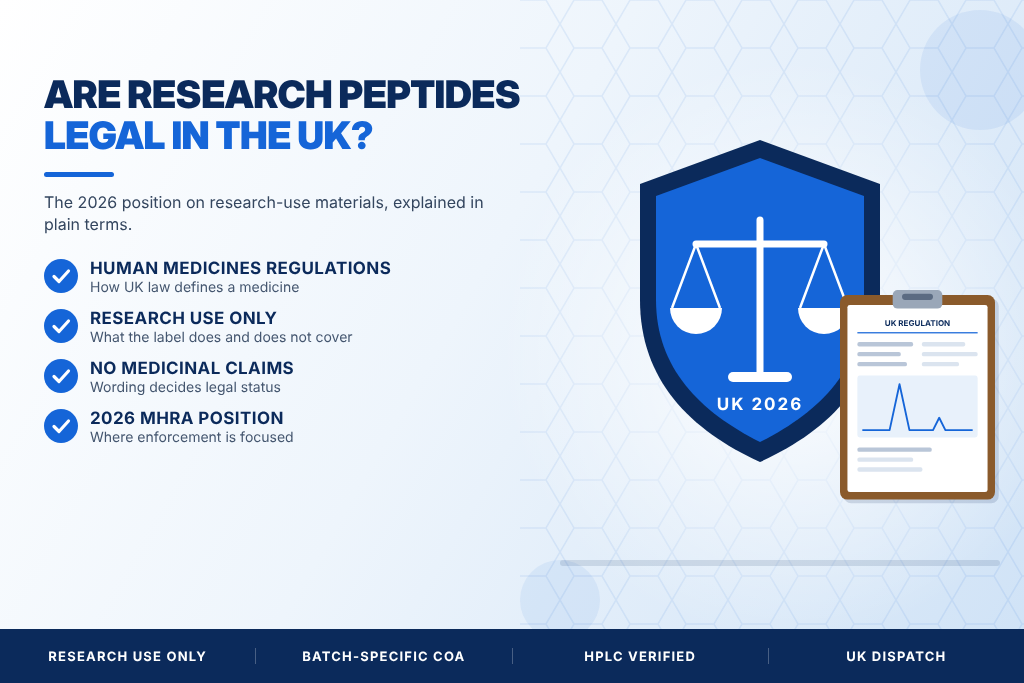
There is no single UK law on peptides. Legal status depends on the specific substance and on how it is sold and described. A peptide sold as a laboratory research material, with no medical claims, is treated differently from the same peptide sold for injection or advertised as a treatment. Some peptides are prescription-only medicines and some are Class C controlled drugs, whatever label they carry.
This article is general information, not legal advice.
How UK law classifies a peptide
The main framework is the Human Medicines Regulations 2012. Under these rules a product is a medicine if it is presented as treating or preventing disease, or if it is used to change how the body works through pharmacological action.
That definition has two parts, and both matter. A product can become a medicine through the claims made about it, even when the substance itself is unlicensed. The Medicines and Healthcare products Regulatory Agency (MHRA) decides borderline cases by looking at the whole picture: wording, images, packaging, dosing information and the intended buyer.
A medicine needs a marketing authorisation before it can be sold or advertised in the UK. Selling an unauthorised medicine is an offence.
Four groups of peptides
| Group | Examples | UK position |
| Licensed prescription-only medicines | Semaglutide, tirzepatide | Supplied for human use only on prescription, through registered pharmacies. Cannot be advertised to the public. |
| Investigational compounds | Retatrutide | Not licensed in the UK or elsewhere. Human use is limited to authorised clinical trials. |
| Unlicensed peptides with no approved use | BPC-157, TB-500, MOTS-c | Not authorised as medicines. Cannot be sold or promoted for human use. |
| Class C controlled drugs | Human growth hormone (somatropin), HCG | Controlled under the Misuse of Drugs Act 1971. Supply without authority is a criminal offence. |
The last group is the one most often misunderstood. Growth hormone and HCG are controlled drugs, and a research-use label does not remove that status.
What “research use only” means
Research use only describes materials supplied for laboratory and analytical work, such as assay development, reference standards and in vitro studies. They are not medicines, supplements or consumer goods. Our page on what research use only means sets out the conditions that apply to every order.
The label has limits. It describes the intended use; it does not create a legal exemption. If a seller’s wider conduct suggests human use, a regulator can treat the product as a medicine regardless of the disclaimer. Dosing instructions, before-and-after images and health claims are the usual triggers.
For a wider introduction to the category, see what research peptides are.
What changed in 2026
In April 2026 the MHRA confirmed it was investigating UK clinics that offered peptide injections, following reporting by The Guardian. According to Aesthetics Journal, the regulator said clinics are not permitted to make medicinal claims about peptide treatments and that it will take action against those in breach.
The peptides named in that reporting included BPC-157, described on one clinic website as aiding tissue repair. The MHRA confirmed that one website was making medicinal claims. Those claims were removed after the clinic was contacted.
The practical point for 2026 is that enforcement attention has moved to how peptides are described. Claims about healing, recovery, fat loss or anti-ageing are what bring a product within the medicines rules.
Advertising and import rules
Two further rules catch sellers and buyers out. First, prescription-only medicines cannot be advertised to the public in the UK. This covers websites and social media as well as print, so promoting semaglutide or tirzepatide by name to consumers is restricted even for a registered pharmacy.
Second, importing does not change a product’s status. A peptide bought from an overseas website is judged under UK law once it arrives, and unlicensed medicines and controlled drugs can be seized at the border. Buyers who order from outside the UK may also find consumer rights hard to enforce, and have no practical way to check where the material was made or how it was stored in transit. A UK-registered supplier with a published address is easier to hold to account.
What a compliant research supplier looks like
A supplier operating within the research category will typically show the following:
- A registered UK company with a published address and company number
- No claims about treating, preventing or improving any health condition
- No dosing, injection or administration guidance
- Batch-specific Certificates of Analysis from an independent laboratory
- Clear terms that restrict sale to adults buying for research
Our supplier checklist covers these points in more detail. The purchase conditions that apply at Zentra Labs are set out in our disclaimer and terms of service.
What buyers are responsible for
Responsibility does not sit with the seller alone. A buyer who purchases research material accepts the conditions of sale and is responsible for using it lawfully. That includes safe storage, proper disposal and compliance with any rules that apply to their institution.
Anyone considering a peptide for a health reason should speak to a GP or pharmacist. Research materials are not manufactured or tested to medicinal standards and are not a substitute for a licensed product.