Quick answer
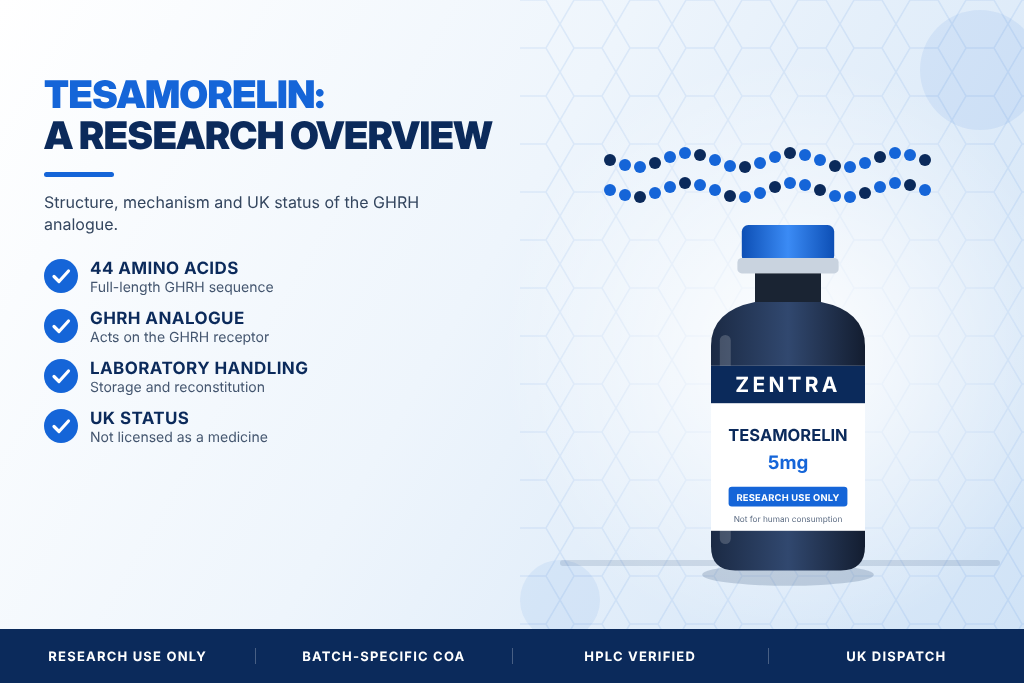
Tesamorelin is a synthetic analogue of growth hormone-releasing hormone (GHRH) made of 44 amino acids. It was approved in the United States in 2010, under the brand name Egrifta, for reducing excess abdominal fat in people with HIV-associated lipodystrophy. It is not licensed as a medicine in the UK, where it is available only as a laboratory research material.
What tesamorelin is
Natural GHRH is a 44-amino-acid hormone made in the hypothalamus. It is broken down in the blood within minutes, which limits its use in research and medicine.
Tesamorelin keeps the full 44-amino-acid sequence and adds a small chemical group, trans-3-hexenoic acid, to the first amino acid. This modification protects the peptide from the enzyme that normally cleaves GHRH, so it stays intact for longer.
| Property | Value |
| Length | 44 amino acids |
| Modification | Trans-3-hexenoic acid on the N-terminal tyrosine |
| Molecular formula | C221H366N72O67S |
| Molecular weight | About 5,136 Da |
| CAS number | 218949-48-5 |
| Development code | TH-9507 |
| Target | GHRH receptor |
How it works
Tesamorelin binds to the GHRH receptor on cells in the pituitary gland. According to DrugBank, this is its listed pharmacological target. Receptor activation leads the pituitary to produce and release growth hormone.
This is an indirect mechanism. Tesamorelin does not supply growth hormone; it signals the body’s own system to release it. For researchers, that distinction matters because the normal feedback loops that regulate growth hormone remain in place.
How it compares with related peptides
Several research peptides act on the growth hormone axis, through two different receptors.
| Peptide | Class | Receptor | Length |
| Tesamorelin | GHRH analogue | GHRH receptor | 44 amino acids |
| CJC-1295 | GHRH analogue | GHRH receptor | 29 amino acids, modified |
| Sermorelin | GHRH fragment | GHRH receptor | 29 amino acids |
| Ipamorelin | Growth hormone secretagogue | Ghrelin receptor | 5 amino acids |
Tesamorelin is the only one of these to have completed phase 3 trials and received a regulatory approval. That gives it a larger body of published clinical data than the others. Zentra Labs also supplies a CJC-1295 and Ipamorelin blend for laboratories studying the two receptor pathways together.
Clinical history
Tesamorelin was developed by the Canadian company Theratechnologies. Its phase 3 programme studied people with HIV who had excess visceral abdominal fat, a feature of lipodystrophy linked to older antiretroviral treatment.
The US Food and Drug Administration approved it for that single indication in 2010, and Canada followed in 2014. It has not been approved for general weight management, bodybuilding or anti-ageing use in any country.
Safety information from the approved product is relevant to anyone reading the literature. DrugBank notes that tesamorelin may cause glucose intolerance and can raise the risk of type 2 diabetes, and that it is contraindicated in pregnancy.
Current research interest
Published work on tesamorelin has moved beyond its original indication. Three areas appear most often in the literature.
- Liver fat. A randomised trial in people with HIV and fatty liver disease, published in The Lancet HIV in 2019, reported lower liver fat with tesamorelin than with placebo.
- Visceral fat distribution. Because the approved indication concerns visceral fat and not total body fat, the compound is used to study how the growth hormone axis affects fat stored around the organs.
- Cognition and ageing. Smaller studies have examined tesamorelin in older adults and in mild cognitive impairment. These are early findings and have not led to any approved use.
A new formulation was approved in the United States in 2025. It changed how the licensed product is prepared, not what it is approved for. None of this research supports use outside a licensed, supervised setting.
Regulatory status in the UK
Tesamorelin has no UK marketing authorisation. It cannot be prescribed as a licensed medicine here, and it cannot be sold or advertised for human use.
As a GHRH analogue it is a different substance from growth hormone itself, which is a Class C controlled drug in the UK. Researchers should still confirm the current legal position for their own institution before ordering. Our page on research use only sets out the conditions of supply.
Tesamorelin is also prohibited in sport. Growth hormone-releasing hormone and its analogues are listed by the World Anti-Doping Agency under category S2.
Laboratory handling
Tesamorelin is supplied as a lyophilised powder. At 44 amino acids it is a larger and more fragile peptide than short sequences such as BPC-157, so handling affects the quality of results.
Storage. Keep unopened vials cold, dry and away from light. Our guide on how to store research peptides gives temperature ranges for lyophilised and reconstituted material.
Transport. Temperature swings during shipping can degrade larger peptides. See our article on cold-chain storage.
Reconstitution. Add solvent slowly down the side of the vial and swirl gently. Shaking can cause aggregation. The full method is in how to reconstitute peptides.
Verification. The Certificate of Analysis should show an observed mass close to 5,136 Da and an HPLC chromatogram for the batch. Ask the supplier which laboratory ran the analysis and whether the report is specific to the batch number printed on the vial.
Zentra Labs supplies tesamorelin 5mg for laboratory research with batch documentation. It is not supplied for human or animal use.