A Certificate of Analysis (COA) is one of the most important documents in peptide research. It provides analytical data that helps verify both the identity and quality of a product. Many researchers find COAs difficult to interpret. This guide explains how to read a peptide COA correctly, what the key sections mean, and which red flags to watch for.
A peptide certificate of analysis is also the simplest way to confirm you are working with third-party tested peptides rather than material backed only by a supplier’s own claims. For UK laboratories comparing suppliers, the certificate of analysis peptides are shipped with should be batch-specific and issued by an independent laboratory.
What Is a Certificate of Analysis?
A COA is a formal laboratory document that reports the analytical results for a specific product batch. It answers two critical questions:
- Is this the correct compound?
- How pure is it?
Think of the COA as a fingerprint. It links your vial to a specific manufacturing run. Without this traceability, you are working with unknowns. Understanding a COA is essential for any serious researcher.
Why COAs Matter in Peptide Research
The quality of your material directly affects experimental results. Even a peptide that appears pure can hide problems such as synthesis by-products, deletion sequences, or incorrect compounds.
A proper COA helps protect against several risks:
- Product substitution
- Impurities that can interfere with experiments
- Degradation caused by poor storage
- Contamination that affects sensitive assays
When evaluating peptide suppliers, the COA should carry more weight than price alone.
Key Sections of a Peptide COA
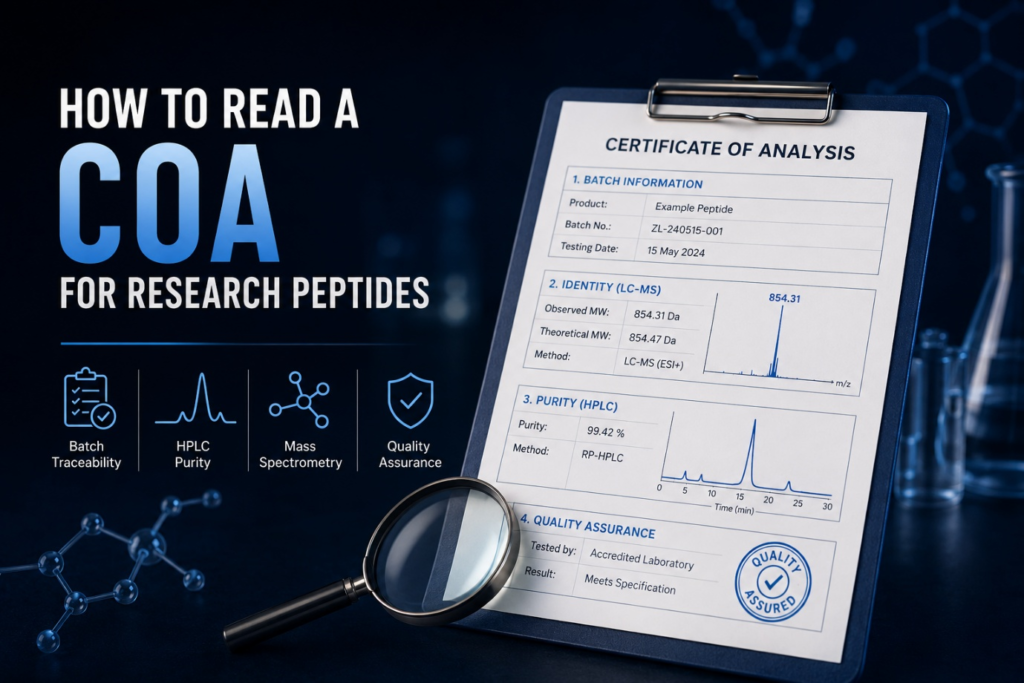
- Batch Traceability and Sample Identification
This section links the document to your specific product. It typically includes:
- Product name
- Amino acid sequence (one-letter code)
- Lot or batch number
- Net weight
- Testing date
The batch number is non-negotiable. A COA without a matching batch number has no value. Always confirm that the number on the COA matches the number on your vial.
- Identity Confirmation by Mass Spectrometry
The most fundamental question is whether the material is the compound you ordered. Mass spectrometry (MS) answers this.
The COA should report both the observed molecular weight and the theoretical molecular weight. These values must match within an acceptable tolerance (usually ±0.5 Da for smaller peptides).
Why this matters: A product can show 99.9% HPLC purity and still be the wrong compound. High purity of an incorrect substance is still useless for research. LC-MS confirmation ensures that purity data applies to the correct molecule.
At Zentra Labs, every batch undergoes LC-MS identity confirmation so that purity data is matched to the right compound.
- Purity by HPLC
High-Performance Liquid Chromatography (HPLC) measures the percentage of the target peptide in the sample.
Purity % = (Target peak area ÷ Total peak area) × 100
Research-grade peptides typically require ≥98% HPLC purity. Many reputable suppliers now aim for ≥99%.
HPLC detects peptide-related impurities such as truncated sequences, deletion peptides, and oxidation products. However, it does not measure:
- Water content
- Counter-ions (such as TFA)
- Heavy metals
- Residual solvents
This means a product labelled “99.9% pure” can still contain water, salts, or residual solvents. A complete COA should include the chromatogram (or at least numerical results) and ideally state the method conditions. Look for a single dominant peak — multiple large peaks often indicate impurities.
- Peptide Content and Net Weight
Net Peptide Content (NPC) measures the actual active peptide fraction after accounting for residual water and counter-ions. HPLC purity does not measure this.
This distinction is important. One milligram of powder is not necessarily one milligram of pure peptide. For example, if a 5 mg vial has an NPC of 85%, it contains approximately 4.25 mg of peptide, with the remainder being salts and water.
Researchers calculating molar concentrations should use:
Molar amount = (Gross weight × NPC% × HPLC purity%) / (Molecular weight × 10,000)
- Testing Laboratory Information
A reliable COA should clearly identify the testing laboratory, including:
- Laboratory name
- Contact details
- Accreditation status (UKAS is the standard in the UK)
- Analyst signature or verification
- Analysis date
Third-party testing is generally more credible than in-house testing because it removes potential conflicts of interest.
- Additional Quality Metrics
Some COAs include further tests depending on the intended research application:
- Heavy metals screening – checks for contaminants such as lead, arsenic, or mercury
- Endotoxin testing – important for cell culture work (results should typically be below 0.05 EU/mL)
- Residual solvents – leftover from synthesis processes
- Appearance – physical description of the material
Zentra Labs provides comprehensive testing on every batch, including HPLC purity, mass spectrometry identity confirmation, and residual solvent profiles where applicable.
How to Spot Red Flags on a COA
Watch for these warning signs:
- Missing batch numbers – No batch number means no traceability
- Generic or reused COAs – The same document used for multiple products has little scientific value
- No independent laboratory – COAs issued only on the supplier’s letterhead are less reliable
- No mass spectrometry data – HPLC alone does not confirm identity
- No testing date – Outdated results may not reflect the current condition of the material
Generic vs. Batch-Specific COAs
Batch-specific COAs are linked directly to your vial through a matching lot number. They reflect the actual quality of that batch and can usually be verified with the testing laboratory.
Generic COAs are not linked to a specific batch and therefore have limited scientific value.
Always request a batch-specific COA. At Zentra Labs, every product is shipped with matching batch documentation.
Conclusion
Understanding a Certificate of Analysis allows you to evaluate peptide quality with greater confidence. Focus on batch traceability, mass spectrometry identity confirmation, HPLC purity, and independent laboratory testing.
At Zentra Labs, every product is supported by clear, batch-specific documentation so researchers can verify quality before starting work.
Explore our research peptides and review the supporting documentation for each product. If you have questions about COAs or testing methods, our team is available to help.
A clear COA is one of several points covered in our UK research peptide supplier checklist.