When research peptides arrive as lyophilised powders, they usually need to be reconstituted before use in laboratory experiments. Two solvents are commonly considered for this step: bacteriostatic water and sterile water.
This article explains the practical differences between the two options and outlines what laboratory teams typically consider when choosing a solvent for peptide reconstitution. All guidance is intended strictly for research use only.
Why Reconstitution Matters
Most research peptides are supplied in lyophilised (freeze-dried) form. This helps protect stability during storage and shipping. Before the material can be used in an experiment, it must be dissolved in a suitable solvent.
The choice of solvent can influence how the peptide is handled after reconstitution, how long the solution remains usable under laboratory conditions, and how contamination risks are managed.
What Is Sterile Water?
Sterile water is water that has been treated to remove microorganisms. It contains no preservative.
In laboratory settings, sterile water is sometimes used for single-use reconstitution. Because it has no preservative, any opened vial or prepared solution is generally treated as a single-use material.
Key points about sterile water:
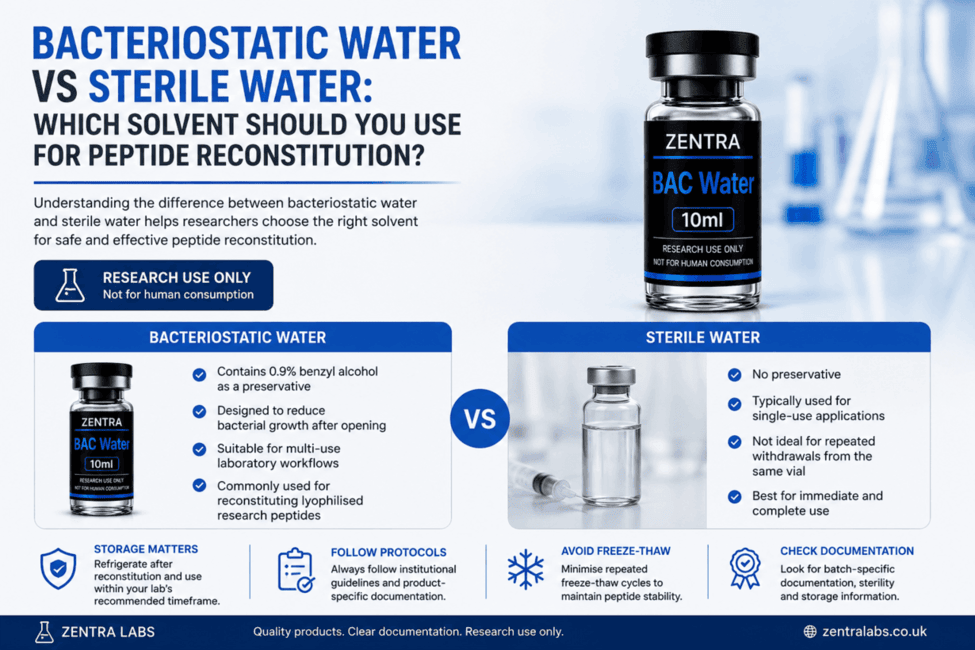
- No preservative
- Typically used for single-use applications
- Not ideal for repeated withdrawals from the same vial
Sterile water can be appropriate when the reconstituted peptide will be used immediately and completely.
What Is Bacteriostatic Water?
Bacteriostatic water is sterile water that contains a preservative, usually 0.9% benzyl alcohol. The preservative helps inhibit the growth of bacteria after the vial has been opened.
This makes bacteriostatic water more practical for situations where a researcher may need to withdraw material from the same vial more than once.
Key points about bacteriostatic water:
- Contains 0.9% benzyl alcohol as a preservative
- Designed to reduce bacterial growth after opening
- More suitable for multi-use laboratory workflows
- Commonly used for reconstituting lyophilised research peptides
Which Solvent Should Laboratories Choose?
There is no single correct answer for every situation. The choice depends on the experimental workflow:
- Sterile water is often preferred for single-use reconstitution
- Bacteriostatic water is generally preferred when repeated access to the reconstituted solution is required
Researchers should also consider institutional protocols and any specific guidance provided with the peptide or solvent.
Storage After Reconstitution
Once reconstituted, research peptides are usually more sensitive than in lyophilised form. Many laboratories refrigerate reconstituted solutions and aim to use them within a defined period according to their own protocols.
Storage and handling requirements can vary by peptide. Always refer to the product-specific or batch-specific documentation supplied with the material, and follow institutional laboratory guidelines. Avoiding repeated freeze-thaw cycles is commonly recommended.
Documentation and Quality Points
When sourcing bacteriostatic water or sterile water for research use, laboratories typically look for clear product information and supporting documentation where available.
- Clear research-use-only designation
- Batch-specific documentation where provided
- Storage guidance
- Packaging and sterility information
Research Use Only
Both bacteriostatic water and sterile water discussed in this context are intended for laboratory research purposes. They are not medicines and are not intended for human administration.
All peptides reconstituted with these solvents remain research compounds only. They are not for human consumption, medical use, therapeutic use, or veterinary use.
Final Notes
The choice between bacteriostatic water and sterile water depends on how the reconstituted peptide will be used. Sterile water suits single-use situations. Bacteriostatic water is generally more practical when repeated access to the vial is required.
In both cases, careful handling, clear labelling, and correct storage support better experimental control. Researchers should always follow their institutional protocols and review the available product documentation before use.
Zentra Labs is a UK-based supplier of research peptides and related laboratory materials. Batch-specific documentation is available to support research teams. Explore the shop.
Storage temperature matters as much as solvent choice; see our guide to cold-chain storage for research peptides.