Quick answer
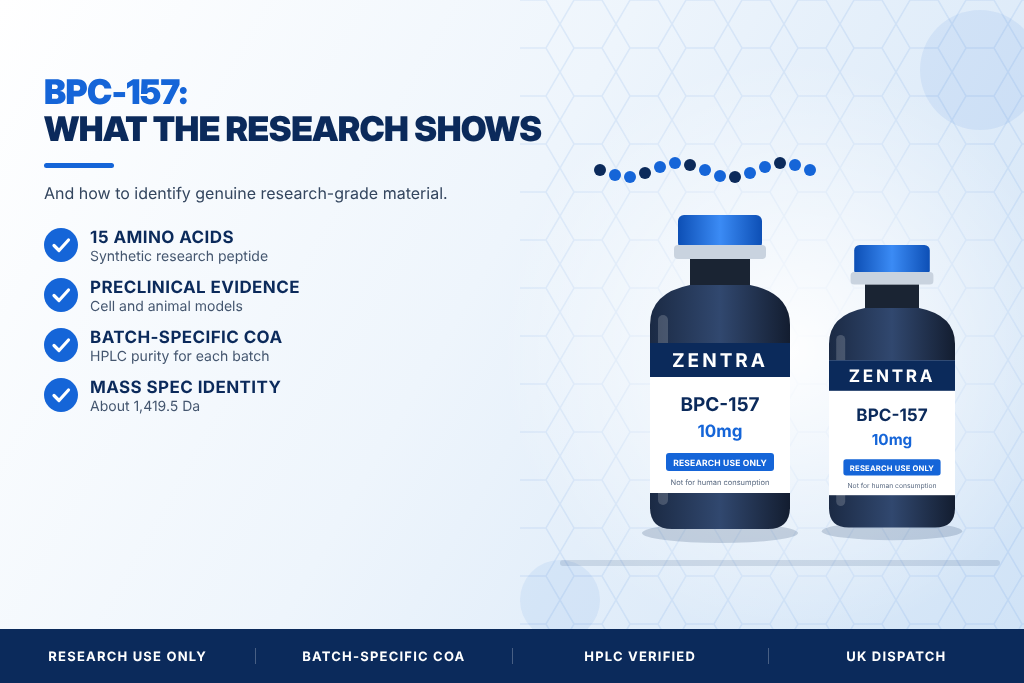
BPC-157 is a synthetic peptide of 15 amino acids that has been studied mainly in cell cultures and animals. No completed controlled human efficacy trial has been published, and it is not licensed as a medicine in the UK. Genuine research-grade BPC-157 is identified by a batch-specific Certificate of Analysis showing HPLC purity and a mass spectrometry result that matches its molecular weight of about 1,419 Da.
What BPC-157 is
BPC stands for Body Protection Compound. The peptide was first described by a Croatian research group led by Predrag Sikiric, which reported it as a fragment of a protein found in gastric juice.
| Property | Value |
| Length | 15 amino acids |
| Sequence | Gly-Glu-Pro-Pro-Pro-Gly-Lys-Pro-Ala-Asp-Asp-Ala-Gly-Leu-Val |
| Molecular formula | C62H98N16O22 |
| Molecular weight | About 1,419.5 Da |
| CAS number | 137525-51-0 |
| Usual form | Lyophilised powder |
The origin story is disputed. According to a review by the Banned Substances Control Group, the full sequence of the parent protein was never published, so the derivation has not been independently reproduced.
What the published research shows
Most BPC-157 literature consists of preclinical studies, largely in rodents and largely from one research group. These studies have examined the peptide in models involving the gut lining, tendons, ligaments and blood vessel formation.
Preclinical results are a starting point for research. They show what a compound does in a specific model under specific conditions. They do not show that the same effect occurs in people, or that the compound is safe.
What the research does not show
The human evidence base is thin. The BSCG review notes the following:
- Two early-stage clinical trials were registered in 2000, and their results were never published.
- A trial that began in 2015 was cancelled with no published data.
- A 2025 systematic review of 36 studies found no completed controlled human efficacy trials and no comprehensive human safety data.
- One small case series reported that 7 of 12 people with knee pain described relief after an injection. This does not establish efficacy or safety.
Researchers should treat confident online claims about BPC-157 with caution. The gap between the volume of marketing and the volume of controlled evidence is unusually wide for this compound.
Regulatory status in 2026
United Kingdom. BPC-157 has no marketing authorisation and cannot be sold or promoted for human use. In April 2026 the MHRA confirmed it was investigating clinics over medicinal claims, and BPC-157 was among the peptides named in that reporting.
Sport. The World Anti-Doping Agency named BPC-157 in 2022 under category S0, non-approved substances. It is prohibited at all times for athletes under WADA rules.
United States. The FDA flagged BPC-157 in September 2023 as a bulk substance that may present safety risks in compounding. Its current guidance on bulk drug substances says it lacks enough information to know whether the substance would cause harm in humans. On 23 July 2026 an FDA advisory committee voted 8 to 6 to recommend adding it to the 503A bulk substances list. The FDA has not yet made a final decision, and BPC-157 remains unapproved.
How to identify genuine BPC-157
Mislabelling is a documented problem with this compound. Reported issues include wrong identity, wrong concentration and undisclosed ingredients. Five checks reduce that risk.
- Batch-specific COA. The Certificate of Analysis should carry a batch number that matches the vial. Our guide to reading a peptide COA shows where to find it.
- Mass spectrometry result. The observed mass should be close to 1,419.5 Da. This matters because HPLC alone cannot confirm the amino acid sequence.
- HPLC chromatogram. A full chromatogram should be supplied, not only a headline figure. See how HPLC purity is calculated.
- Named testing laboratory. The laboratory should be identifiable and willing to confirm that it issued the report.
- Correct physical form. Lyophilised BPC-157 is a white powder or cake. Discolouration or liquid in a sealed vial suggests a problem.
A supplier that publishes these details makes verification possible. A supplier that does not leaves the researcher unable to confirm what is in the vial. Our supplier checklist covers the wider questions to ask.
Handling and storage
Even genuine material loses value if it is handled badly. Lyophilised BPC-157 should be kept cold, dry and away from light until use. Once reconstituted, a peptide in solution is far less stable than the dry powder, so researchers usually prepare only what an experiment needs.
Our guide on how to reconstitute peptides covers the method and solvent choice. Record the batch number, reconstitution date and solvent in the lab notebook so that results can be traced back to a specific vial.
BPC-157 in combination studies
BPC-157 is often studied alongside TB-500, a fragment of thymosin beta-4. The two are examined together in preclinical models because they act through different proposed pathways. Our article on the BPC-157 and TB-500 research combination summarises that work.
BPC-157 at Zentra Labs
Zentra Labs supplies BPC-157 10mg for laboratory research as a lyophilised powder with a downloadable batch COA. It is not supplied for human or animal use.