Quick answer
“To verify a peptide certificate of analysis, confirm that the testing laboratory exists and is independent, match the batch number on the COA to the vial, check that the report carries a date, a report ID and a named analyst, and contact the laboratory directly to confirm it issued the report. A COA that cannot be traced back to a laboratory is a marketing document, not evidence.”
Why verification matters
A Certificate of Analysis records the identity and purity of one production batch. It is the main document a researcher relies on before using a compound in an experiment. Because it carries that weight, it is also the document most often copied, edited or reused across batches.
Reading a COA and verifying one are separate skills. Our guide on how to read a peptide COA explains what each section means. This article covers the next step: confirming that the document in front of you is authentic.
Seven checks to confirm a COA is genuine
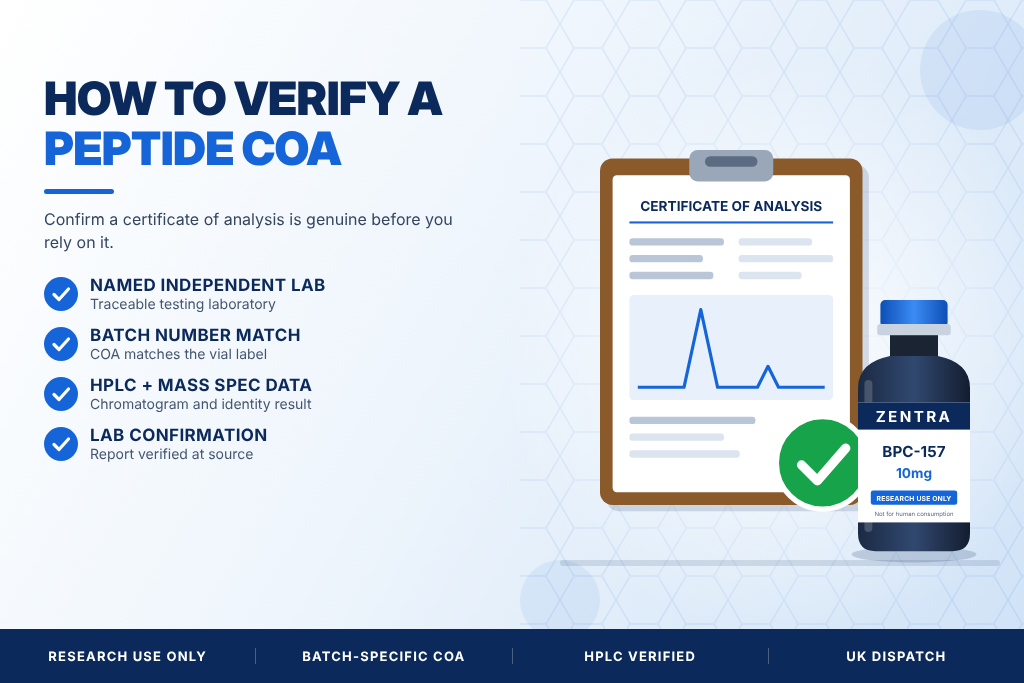
- Identify the laboratory. A genuine COA names the laboratory that ran the analysis, with an address and contact details. Search for the laboratory independently and confirm it is a real analytical business. Do not rely on a phone number or link printed on the COA alone. In the UK, accredited laboratories display the national accreditation symbol described in the government guidance on the UKAS accreditation logo.
- Confirm the laboratory is independent. Third-party testing means the laboratory has no ownership link to the seller. An in-house COA still has value, but it is not independent evidence. If a supplier advertises third-party tested peptides, the report should come from a separate company.
- Match the batch number. The batch or lot number on the COA must match the number printed on the vial label. If the vial has no batch number, the COA cannot be linked to it. One COA reused across many months of stock is a warning sign.
- Check the report details. Look for a report or sample ID, the date the sample was received, the date of analysis and the name or signature of the analyst. Missing dates and unsigned reports are common in fabricated documents.
- Look for raw data. A complete report includes the HPLC chromatogram and the mass spectrum, not only a summary line saying “99% pure”. The chromatogram should show a main peak with a retention time and an area percentage. Our explainer on HPLC purity shows how that percentage is calculated.
- Check the identity result. Purity and identity are different tests. HPLC shows how much of the sample is one compound. Mass spectrometry shows whether that compound has the expected molecular weight. The observed mass on the report should sit close to the theoretical mass of the peptide.
- Contact the laboratory. This is the strongest check. Send the laboratory the report ID and batch number and ask it to confirm that it issued the report. Many laboratories also print a QR code or verification code that resolves to a page on their own domain. Check that the web address belongs to the laboratory and not to the seller.
Red flags that suggest a COA is not genuine
| Red flag | What it usually means |
| No laboratory named | The result cannot be traced or confirmed |
| Same COA for every batch | The document is generic, not batch-specific |
| Purity shown as exactly 100% | Real HPLC results almost never read 100.00% |
| No chromatogram or spectrum | Only a summary was produced, or the data was removed |
| Blurred text or mismatched fonts | The file may have been edited |
| Analysis date older than the batch | The report belongs to different material |
| Verification link on the seller’s own site | The check is not independent |
One red flag does not prove fraud. Several together mean the document should not be relied on.
What a COA cannot tell you
A genuine COA still has limits. It describes the sample that was tested, not every vial in the batch. It does not show how the material was stored after testing, which is why storage conditions matter after delivery.
A standard purity and identity report also does not cover everything. Sterility, endotoxin levels and net peptide content are separate tests. If an experiment depends on those values, ask the supplier whether they were measured and request the data.
Questions to ask a supplier
A supplier that tests properly will answer these without difficulty:
- Which laboratory tested this batch, and can I contact it?
- Is the COA specific to the batch number on my vial?
- Can you send the full chromatogram and mass spectrum?
- When was the batch tested?
- Were sterility or endotoxin tests carried out?
These questions form part of a wider review. Our UK supplier checklist covers the remaining points, including company registration and dispatch.
How this applies at Zentra Labs
Each product page in our research peptide shop links to the COA for the current batch. Researchers who need further documentation can request it through our contact page before ordering. All materials are supplied for laboratory research only and are not for human or animal use.